Solution for Intelligent Monitoring Systems for Data Center Infrastructure (Environment, Power, and Energy Consumption)
Smart data center infrastructure monitoring system for real-time environment, power, and energy consumption monitoring with remote management, alarm alerts, and energy efficiency analysis.
2026/09/10
Reading volume: 1
Case Details
Chapter 1: Company Profile
With energy-saving monitoring as its core business, the company focuses on the refined energy management of households, enterprises, government agencies, and schools. We provide comprehensive energy-saving monitoring solutions, including electrical energy metering management systems, building energy consumption analysis systems, energy management systems for industrial and mining enterprises, and resource management systems (water, electricity, gas, and heat) for schools. Our product portfolio includes smart metering sockets, energy-saving sockets, smart electricity meters, DIN-rail smart meters, multifunctional digital instruments, energy data acquisition terminals, and data concentrators, alongside the provision of technical solutions for these products.
The company adheres to a business strategy driven by technology and guided by the market, upholding the philosophy of "co-creation, sharing, mutual progress, and win-win outcomes." We boast a team of young, dedicated, and highly qualified technical and management professionals. As a learning organization, we encourage learning through work and working through learning, emphasizing continuous, incremental improvement. Innovation is the eternal pursuit of the Senwei team; we drive development through technological innovation and efficiency through management innovation. Our management principles of standardization, specialization, and procedural rigor are integrated into every stage—from product design and manufacturing to customer service—ensuring Senwei’s superior product quality and first-class service standards.
Our mission is to provide the best products and services for energy conservation and emission reduction, and our commitment is to operate with integrity for mutual benefit. We will continue to leverage our technological leadership in smart meters, smart energy-saving sockets, and energy metering management, while constantly innovating to lead the industry's development.
Chapter 2: Overall Solution Planning
1. Solution Background
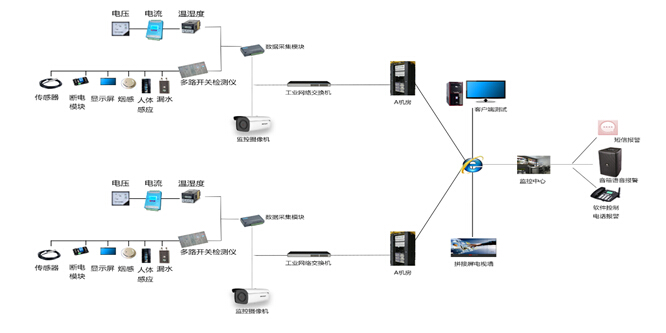
The intelligent monitoring system for server room infrastructure (environment and power) and energy consumption consists of three components: the front-end system within the server room, the transmission network, and the monitoring center. It integrates subsystems such as video surveillance, environmental monitoring, power monitoring, and security protection to provide real-time monitoring and alarm detection for environmental conditions, equipment operation status, and on-site security. To enhance safety and operational management in unmanned server rooms, the system enables remote management from the monitoring center and offers multiple alarm methods—including audible and visual alarms, telephone calls, SMS, emails, web pop-ups, web-based audio alerts, and WeChat notifications. This ensures that server room administrators receive alarm information promptly, meeting the requirements for efficient management and safe operation. 2. Solution Composition and Structure Diagram
2.1 System Structure
2.2. Technical Characteristics of the Master Station Communication Network
The system comprises monitoring equipment, data acquisition modules, industrial switches, and a master station. Direct connections to the master station are established via the switches, offering the greatest ease of installation and the highest level of reliability.
2.3. System Security
This communication system consists of a two-level network architecture. Each communication level operates independently, utilizing dedicated lines for network formation with no interdependencies; the systems require only mutual network interfaces, thereby ensuring a high level of security for the entire system.
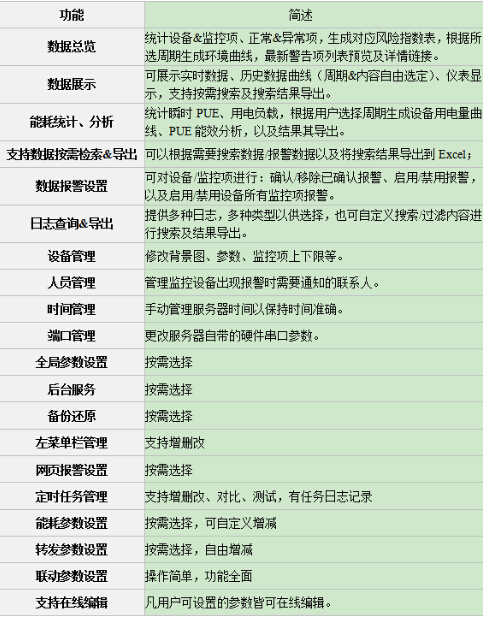
3. Functional Overview of the Solution
Chapter 3: Introduction to System Components
1. System Software
1.1 System Overview
The Intelligent Monitoring System for Server Room Environment, Power, and Energy Consumption is a professional software platform for energy-saving management. Hosted on the Alibaba Cloud platform, it features powerful capabilities, ease of use, and an aesthetically pleasing interface. Engineering personnel can flexibly configure the platform to build system products tailored to various application fields. By monitoring equipment such as end-point power loads, the system achieves centralized management of energy consumption data. It establishes a centralized management platform based on an Ethernet network structure and supports upward integration. Adhering to principles of distributed data acquisition, centralized monitoring, and resource/information sharing, the system is an industry-standard distributed management system.
The management platform is built on .NET technology and employs a hybrid B/S (Browser/Server) and C/S (Client/Server) architecture. Front-end elements—such as the user interface and user operations—utilize the B/S architecture, while back-end tasks—such as engineering configuration and data modeling—rely on the C/S architecture. The underlying layer employs data warehouse technology widely used in sectors like finance and retail; by constructing data cubes tailored to the needs of different project types, the system performs in-depth data mining and analysis regarding energy consumption. Additionally, the UI layer offers free configuration capabilities to maximize the satisfaction of evolving user needs, ensuring the system is user-friendly and easy to maintain.
1.2 System Composition
The system software comprises a login management module, an archive management module, a daily operations management module, a query and statistics module, and an emergency handling module (see the functional module diagram for details). The functions of each module are as follows:
Login Management Module: Manages and controls operator system logins.
Archive Management Module: Provides unified, systematic management of system parameters, organizational structure, operator details, user types, and more.
Daily Operations Management Module: Manages daily operational tasks by category.
Statistics and Query Module: Enables querying and statistical analysis of data such as user information, power sales records, operation logs, and power adjustment details.
Emergency Handling Module: Facilitates on-site troubleshooting during special or emergency situations.
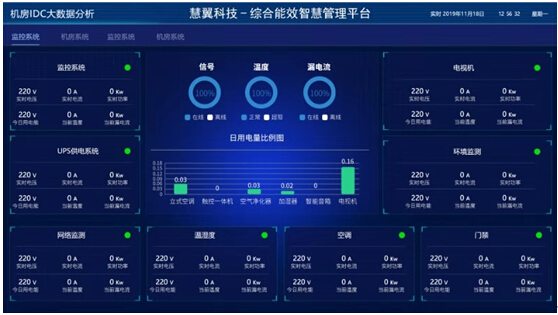
1.3 Standard System Main Interface:
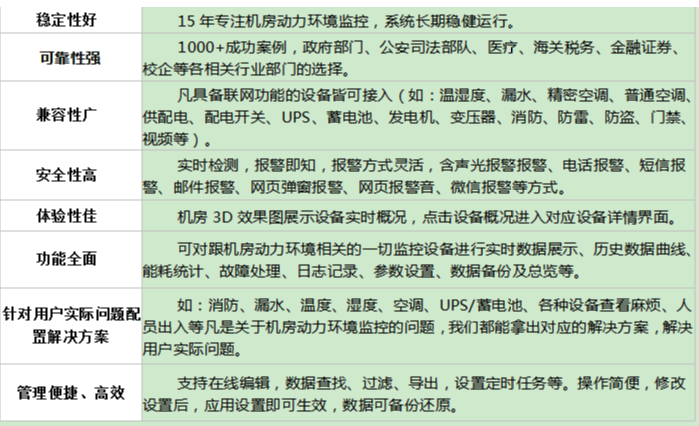
1.4 System Advantages and Features
Chapter 4: System Configuration Requirements and List
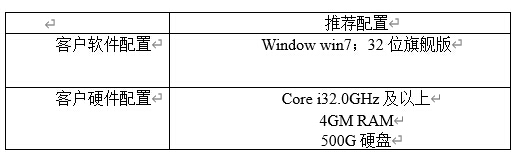
1. Client Configuration
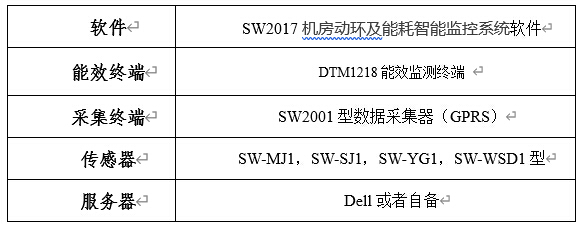
2. System Configuration List
Chapter 5: After-Sales Service
1. Service Principles
Principle 1: Meeting customer needs is the highest priority.
Principle 2: Resolve customer issues quickly and effectively.
Principle 3: Bring happiness to customers through service.
Principle 4: Solve problems right the first time; avoid repetitive service calls.
Principle 5: Prioritize the continuous improvement of service quality.
2. Service Guarantees
We implement a "Four-Dimensional Service" approach: Multi-dimensional, Professional, Long-term, and Contract-based.
3. Service Items
※ Training on system operation and usage.
※ Training on product installation, parameter configuration, and system commissioning.
※ Troubleshooting common issues and system maintenance.
※ Establishing system operation management models tailored to user needs.
※ Product repair, upgrades, and replacements.
※ Consulting services regarding advanced industry management practices.
4. Service Commitments
※ Product quality warranty period: 12 months. The company assumes full responsibility for free maintenance or replacement regarding any quality issues arising during this period.
※ One-year free after-sales service period. All service personnel have undergone professional technical training; we never assign unqualified or non-professional staff to serve customers.
※ Recommend the industry's most advanced application technologies and management models to customers, and provide detailed solutions.
※ Products recommended and supplied to customers are guaranteed to be the latest technology currently in production; we proactively recommend upgrade solutions whenever new technologies are implemented.
※ Provide a complete set of documentation—including system operation management guidelines, maintenance procedures, and user manuals—enabling customers to master application and maintenance independently; we never withhold technical information required for maintenance.
※ Immediate response to complaints with a 100% resolution rate. On-site service response times: within 4 hours for the local city area, within 24 hours for locations within the province, and within 48 hours for locations in other provinces/cities.
※ Conduct regular proactive on-site visits and submit system operation reports.
Share to:


)


How a Trusted Smart Energy Meter Manufacturer Powers Global B2B Projects
Electricity Solutions for Agricultural Irrigation


